Leverage the power of culturally responsive teaching to accelerate students’ academic achievement.
ALL STUDENTS ARE WIRED TO LEARN. But we have underdeveloped the cognitive capacity for some.
You see it every day: students who’ve fallen behind in reading, who struggle to keep up in math. Not because they can’t learn—but because the way we’ve designed teaching doesn’t close their existing learning gaps. You’re trying to get students where they need to be but you’re still not seeing the growth your students deserve.
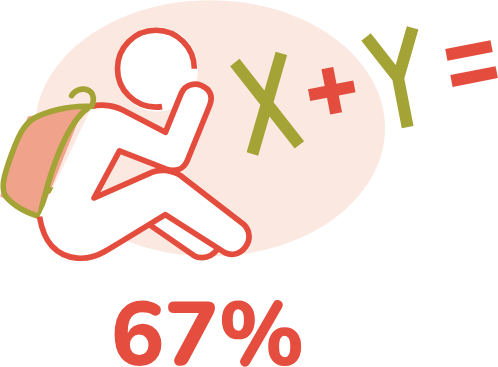
Reading Proficiency Has Dropped
of eight-grade students
performed at or above NAEP
Proficient in 2024, lower than
in previous years.1
of teachers say that math
anxiety was a challenge
for their students.2
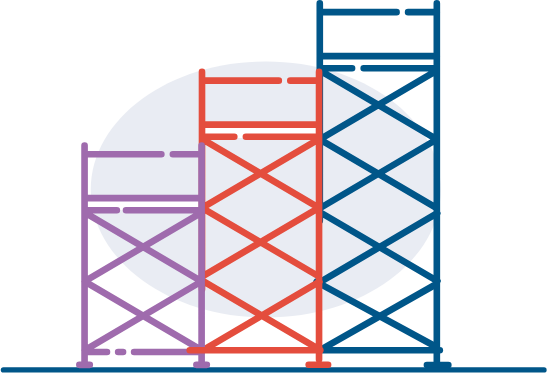
Too Much Support, Not Enough Struggle
When educators over-scaffold, they inadvertently limit students’ capacity to build their own cognitive muscles.
Culturally Responsive Teaching When Done Effectively Offers the Next Generation of Instructional Innovation.
First generation equity initiatives focused on providing more diverse content. Second generation equity initiatives have focused on providing high-quality, grade-level materials.
With growing majority-minority student demographics, culturally responsive teaching is ushering in the third generation of instructional innovation.
Culturally Responsive Teaching Leverages...
Social
Neuroscience
The Science
of Learning
Cultural Funds
of Knowledge
More than a motivation gimmick, culturally responsive instruction builds each student’s capacity to be the leader of their own learning.
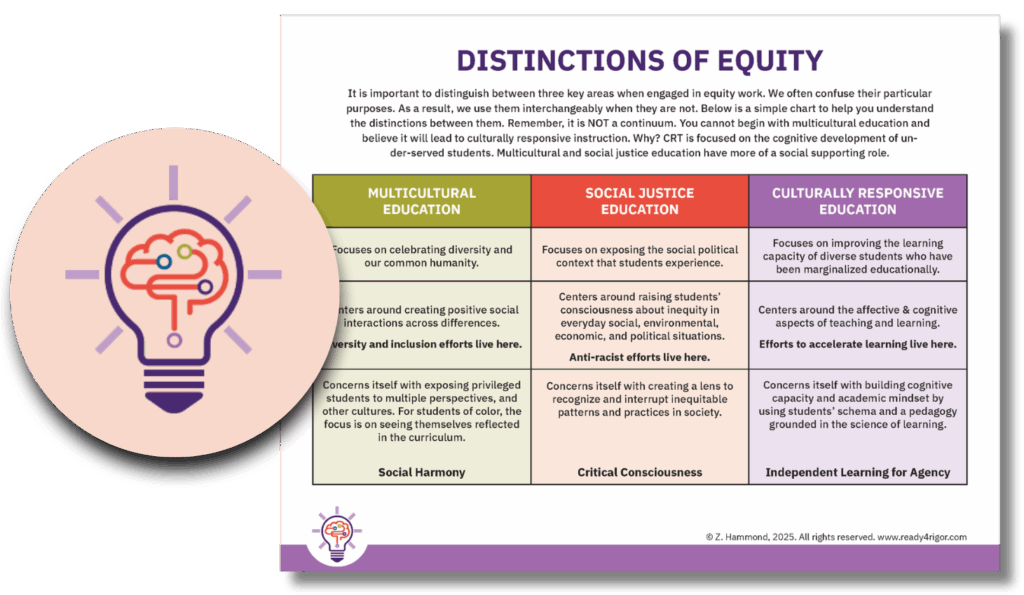
The Distinctions of Equity
How Culturally Responsive Teaching
Differs from Social Justice Education
Build the Will, Skill, Knowledge, and Capacity
That Changes Outcomes for Students.
Most approaches to culturally responsive teaching focus only on diversifying content or building relationships with students. The Ready for Rigor® Framework takes you further.
Get students ready to take on more rigor by improving their information processing skill—not just executive function
Build a learning partnership with students that allows you to coach, not just a friendly relationship with no trust
Establish a cognitive apprenticeship in the classroom that disrupts Processing the all too common pedagogy of compliance
Sharpen your awareness lens to recognize inequitable practices masquerading as helpful instruction
We are here to support you
to operationalize culturally
responsive teaching practices
So you can help students close their
learning gaps quickly and regain
their learning power.
Based on bestselling book Culturally Responsive Teaching and the Brain, the Ready for Rigor® Framework will help you create the instructional moves, routines, and structures that result in a classroom where students thrive and are prepared to tackle rigorous learning.
Explore Ways to Operationalize the Ready for Rigor® Framework
Ready to begin? The four areas of the framework are interdependent and work together. Select an area where you’d like to deepen your understanding and build your skill or capacity. You can use these guiding questions to identify where you are in your journey with culturally responsive teaching and then take the next step in your learning.
Awareness
Understand your context and yourself.
Have I explored how culture shapes how I see, teach, and relate to students?
Do I understand how the brain learns—and how bias can disrupt that process?
Am I aware of how race, language, and identity impact learning in my classroom?
Learning Partnerships
Shift from
power
over to
power with.
Do I see myself as a partner in my students’ learning, not just a deliverer of content?
Am I creating a classroom culture that reduces stress from stereotype threat and microaggressions?
Am I balancing care with high expectations to build student confidence and agency?
Community of Learners
Create a
cognitive
apprenticeship
in the
classroom.
Have I built a learning space where students feel intellectually and emotionally safe?
Do students have voice, agency, and meaningful roles in shaping our classroom?
Am I using collaborative routines and restorative practices to build a strong learning community?
Information Processing
Improve the
brain’s engine
for deeper
learning.
Am I providing the right level of challenge to stretch students’ cognitive capacity?
Do I connect new content to students’ lives, cultures, and ways of making meaning?
Am I using culturally grounded strategies to help students process and retain what they learn?
Join Our Community
Sign up for the Ready for Rigor newsletter to get:
Actionable tips to evolve your practice and empower all students to think, grow, and succeed
Exclusive resources and tools to guide your learning journey
Personal reflections and insights straight from Zaretta Hammond
Early access to information about upcoming courses, events, and more